Posts Tagged ‘chesterhill’

Local Spelt Pizza Crust

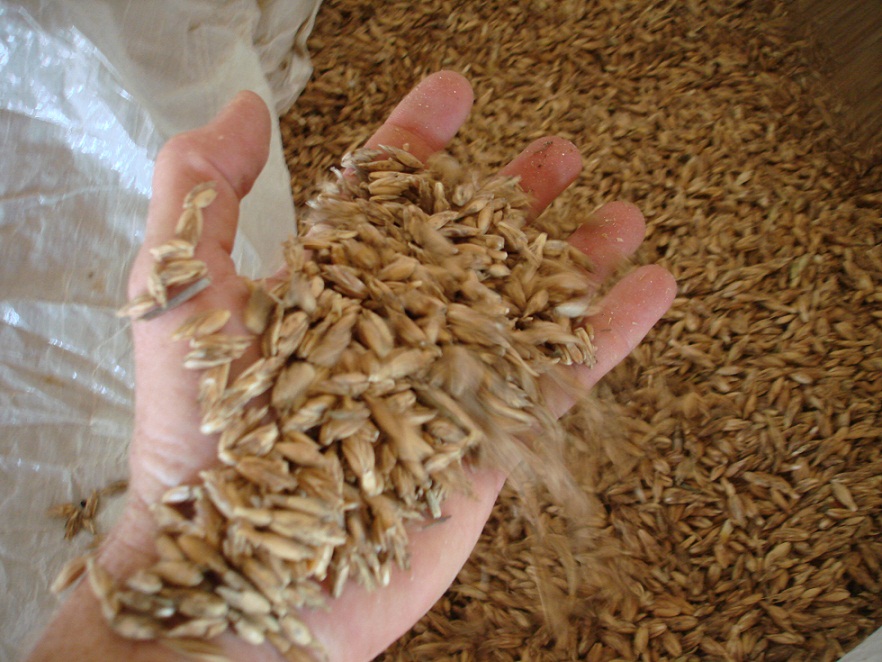
Whole grains of the spelt.

The spelt is here. I have been waiting for this day since the summer of 2009. Back then I drove to my Amish friends in Chesterhill, Ohio to get some late season asparagus and stawberries. As I popped over the roller-coaster road that was being slowly strangled by undergrowth, I came to Joe Hirshberger’s sprawling farm.

The hilly panorama around Chesterhill is like a Grant Wood painting. Undulating hills and steep ravines bottom out into small farm ponds used by horses, cows and sheep. Joe’s  farm is always worked the old fashioned way; with huge hairy-hoofed horses, carriages, buggies, peach trees, drying timber, sheep, chickens, dogs and steel-wheeled contraptions to capture the oats, wheat, spelt and corn. Barefoot kids in straw hats come and go past my window. Off to my right I see the fields where farmers grow, cut and stack all the corn and grains for the season. Closer in, near the road, some Amish women and kids kneel mosque-style (bad analogy.) They look like big black boulders slowly making thier way along the earthen potato rows.
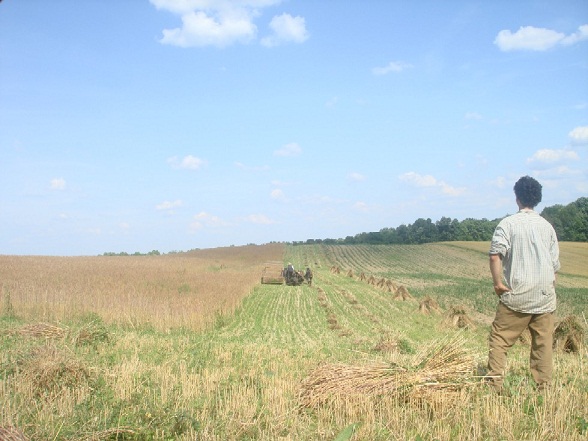
Brandon in the foreground and Joe in the distance, guiding draft horses as they cut the spelt.

Then I see the Hirshberger house over the next hill, and there’s Joe, guiding four huge draft horses as they pull a cutting device through his field. He’s being followed by a dark haired guy stacking up the bundles that joe has cut.

“That job sucks.” I thought, and got out of my air-conditioned comfort to greet them.  Joe halted the horses and flies buzzed around in a moving cloud of chaos. I now regretted getting out of my car, as the air felt like a sauna. A horsefly bit my neck.

“Hi, my name is Brandon,” the dark haired guy said. His shirt was covered in sweat and field debris. “Who are you?’ he asked.

“I’m John, from Avalanche Pizza. Just stopped by to say hi to Joe.” I said, pointing at Joe. I wondered if Brandon was a migant worker. Then realized that I had seen him in the paper. He was that back-to0nature, seed-and-wheat guy who the paper said was bringing back the old-world style connection between local markets and local farmers.
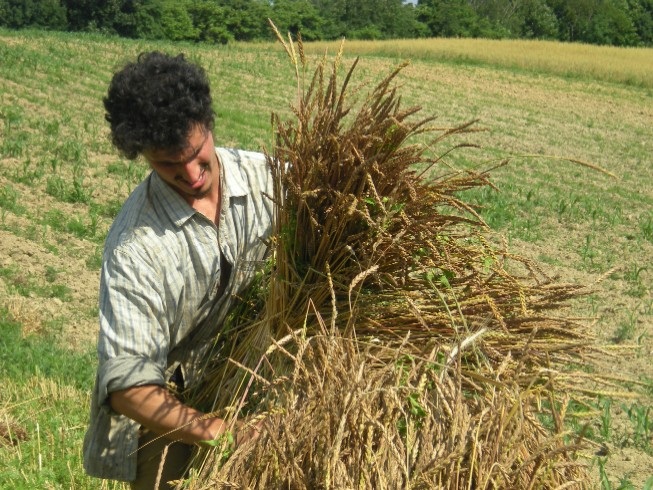
Brandon gathering the spelt after Joe cuts it.

“How do you know Joe?” Brandon asked, just as Joe walked up and shook my hand. Joe’s white collared shirt was soaked but still pulled tight around his neck. His black felt jacket,  black pants, and beard were coated with beige wheat debris. Joe had no shoes on, and as he walked around (he never stands still), I cringed at the thought of those sharp 3-inch stalks stabbing my feet like punji sticks.

“Hello John,” Joe said, stroking his long beard.

“I buy some stuff from Joe every so often,” I explained to Brandon.”It’s a hot one, huh?” I said to both, and realized instantly how stupid a question that was.

“Are you interested in this spelt for your pizzas?” Brandon said.

“What’s spelt?” I asked. Both Brandon and Joe looked at each other quizzically then they both laughed. I thought they were gonna fall down in shared hysterics then realized I was standing in a field of spelt.

Well, that’s how this all started.
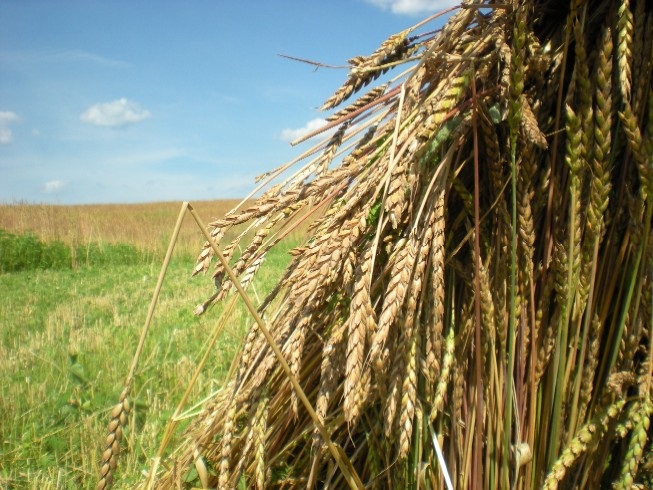
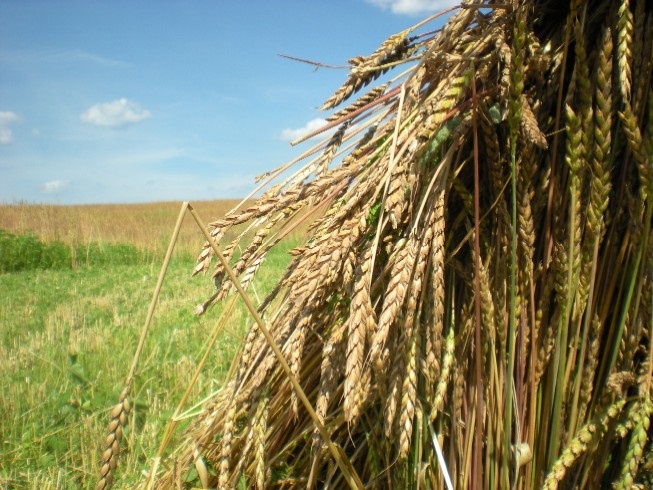
Spelt “on the vine” from Joe’s farm in Chesterhill, Ohio.

From then on, it’s been a great partnership. Joe Hirshberger still puts up with my ignorance about his religion, plants, vegetables, culture, and farm animals. He has taken a big chance on me and has planted part of his valuable acreage for my handshake promise to use his spelt and corn flour.

Brandon and Michelle Ajamian (His partner in Shagbark Seed and Milling) have come though in spades with their new mill and plans for the future. They have ground this hard-shelled grain fine enough for me to work into a crazy-good nutty pizza dough.
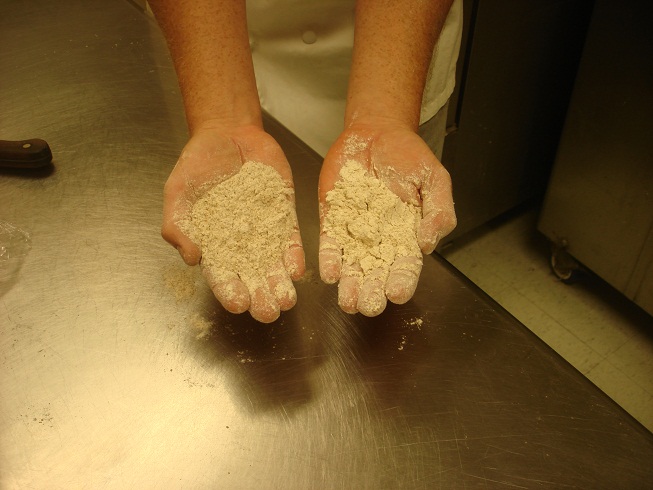
Moist local spelt on the right and the stone ground whole wheat from Con Agra that we had previously used.

This truly local flour has been incorporated into Avalanche Pizza’s menu-mix for a week now.  We’ve sold over 100 pounds of spelt pizza crust and breads in seven days!

Thank you Brandon, Michelle and Joe.

Wild and Local Springtime Pizza

It’s a known fact that the level of artistic activity undertaken by neolithic to ancient tribes was directly related to the free time they had. And this free time was directly related to food. They gained this extra time by using their knowledge about wild foods, then ultimately turning to cultivation for a better yield and more control over their lives.

Pizza with the gift of natural and wild ingredients. My son with his find of a nice wild onion.

Fiddlehead fern bounty hunters with their elusive prey. A wild onion au naturale.

Sometimes though, whole cultures of humans seemed to have vanished slowly. They had no more time for the ornamental trinkets, mounds and carvings. Just a few rocks are proof of their diminished presence. They scattered farther away from their original homes in search of food because the bounty of foods that previously sustained them were used up. Their environment was ruined by carelessness, enviromental changes, lack of foresight and just plain human stupidity.  Life came  down to the simplest of realities: If it was a good year, they lived; if it was a bad year, they died. Most turned back to the forest and wild foods.

Fiddleheads starting to open on a cinnamon fern.  The single morel found in Chesterhill, Ohio

These days, it’s easy to feel trepidation about the direction of our tribe when a large oil company has just contaminated the largest fishing ground in the country. Another e coli outbreak in Romaine lettuce has just been announced in our fair state of Ohio, just another example of an over-extended and unsafe food chain.

Over the years, we’ve been lured by the convenience of the mega-markets with thier narcotic-like bright aisles and perfect vegetables shimmering from the mechanical misting. Thanks to our supreme knowledge of chemicals, the annoying leaves with those gross bug bites are gone. But now, we don’t even know where this food has come from (and don’t even think to question.)

Has grocery shopping, this super easy way to forage, freed up our time for the arts? Have we, like so many tribes before us, used our extra time to build pyramids or make beautiful rock carvings?  Well, no. But we do have 24-hour cable television with interesting programs about lost tribes.

I wanted to do a pizza that is dedicated to the lost art of finding foods from nature. It’s also for all the people who scratch their heads and wonder what our tribe is doing to our environment and our foods.

Kids never forget the great times in the forest.

Unfortunately, foraging for wild food isn’t as easy as it sounds. I enlisted the help of my two best helpers and promised them plenty of mud and puddles. Because it was a promising spring, we ventured out in search of fiddlehead ferns, cossack asparagus, morel mushrooms,  wild ramps and wild onion. To this we would add some locally raised and smoked ham, local goat feta and make a pizza fit for a chief.

But shouldn’t we be careful with the wild plants we forage? Won’t they make us sick? In the words of Euell Gibbons:

“Some readers will claim that they prefer to buy their fruit and vegetables from a supermarket for reasons of sanitation and cleanliness. This is the most illogical prejudice of all, as is the easily demonstated. The devitalized and days-old produce usually found on your grocers shelves has been raised in ordinary dirt, manured with God knows-what, and sprayed with poisons a list of which would read like a texbook on toxicology. They were harvested by migrant workers who could be suffering from diseases, handled by processors and salespeople and picked over by hordes of customers before you bought them.

“By contrast, wild food grows in the clean, uncultivated fields and woods, and has never been touched by human hands until you come along to claim it. No artificial manures, with their possible sources of pollution, have ever been placed around it. Nature’s own methods have maintained the fertility that produced it and no poisonous sprays have ever come near it. Wild food is clean because it has never been dirty. You’ll have to find a better argument than the one on sanitation before you persuade me that I shoudn’t eat wild foods, for in the matter of cleanliness, wild products are so far ahead of those that are sold for profit as not to be within speaking distance.”

– Stalking the Wild Asparagus, 1962

Springtime Pizza

1 Easy Dough Method pizza dough

Fiddlehead Fern Pickle:

1/2 cup fiddlehead ferns

2 tablespoons red wine vinegar

1 teaspoon black peppercorns

1 bay leaf

1 tablespoon soy sauce

2 tablespoons Japanese sake or white wine

1 tablespoon sugar

1 teaspoon salt

For the pizza:

4 to 5 inches of “Cossack Asparagus” (see video) from the middle of the cattail

1 quarter of a lemon

3 strips of lean local bacon or ham

2 tablespoons extra virgin olive oil, divided

5 wild onion bulbs

12 wild ramp leaves

1 tablespoon white wine

1 large morel mushroom or several small ones (substitute Shiitake or Cremini)

3/4 cup goat feta (substitute  feta or chevre)

Make 2 dough balls using the Easy Dough Method on this blog. Freeze one for the next recipe and keep one under a moist cloth ready for forming.

Two hours before finishing the pizza, rinse the fiddleheads and place them in a small pot of water. Bring to a boil. Keep them in the boiling water for 30 seconds. Drain the water and start the process over again. Drain again and cool the ferns in cool water.

Place the remaining ingredients for the pickled ferns into the same small pot.

Bring to a boil, then add the fiddleheads. Immediately turn off the heat and set aside to cool, approximately 10 minutes. Place fiddleheads in a bowl and chill in the fridge, next to the beer.

Prepare asparagus according to my earlier post. (Basically, use a vegetable peeler to peel the skin 3/4 of the way from the bottom. Blanch in boiling water for 20 to 30 seconds, then drench in an ice bath.

Preheat a heavy upside-down cookie sheet on the middle rack of the oven at 450 degrees or use a pizza stone at 460 degrees.

For the cossack asparagus, cut off the white part of the cattail and then cut this portion into inch long pieces. Place in a bowl and spritz with the quarter lemon.

Saute the ham or bacon with 1 tablespoon of olive oil for 2 minutes on medium high heat. Add the wild onion bulbs and ramp leaves.

Remove the ham and wild greens from the pan and deglaze with the tablespoon of white wine. While keeping the heat on, cut the mushroom up into 1 inch pieces and saute in the same pan with the remaining tablespoon olive oil for approximately 1 minute. (Creminis will take a little longer but remember, you will be cooking these again on the pizza.)

Form the dough round and place on the parchment paper. Add the goat cheese first, then the ham and wild greens, and the mushrooms.

Place the asparagus on top (or have the kids do it, then correct them, thus giving them a taste of the control freak you really are.) Place the pizza, still on the parchment paper, on top of the cookie sheet . Cook for 12 to 15 minutes. Start watching the bottom for browning after 10 minutes. The pizza should be golden brown and the bottom more brown and crisp.

Place the fiddlehead ferns and cossack asparagus on the pizza and celebrate wild food, Euell Gibbons, and a Goonish pie.